
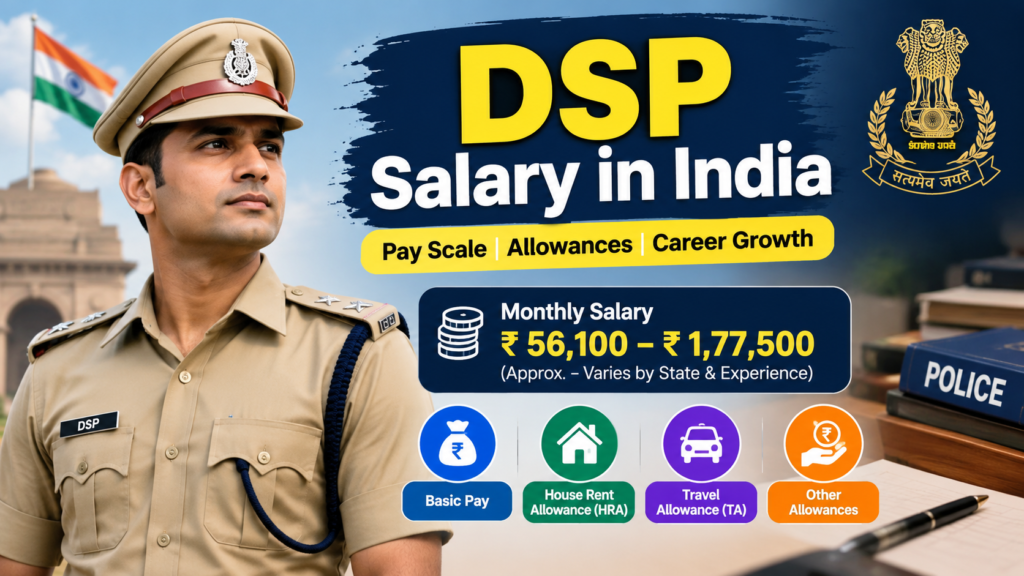
DSP salary is one of the important factors candidates looking for state civil services and police recruitment exams need to ponder about. DSP Deputy Superintendent of Police Senior police officer in charge of maintaining law and order, supervising police personnel and overseeing investigations.
The salary of a DSP depends on the state government, pay level, work experience, perquisites and tax deductions. Basic pay (entry-level) across cash-controlling state services ranges from ~₹56,100/ month to other average salary amounts as per different states. As mentioned in this notification the Uttar Pradesh DGP post is offered at Pay Level 10 with a scale ₹56,100 to ₹1,77,500 as an example
DSP Salary per Month – In-hand Salary, Grade & Pay Scale, Allowances, State-Wise Difference, Eligibility for Direct Recruitment in 2023, Promotion and Career Growth in this article.
DSP Salary in India Overview 2026
The following is a brief summary of the DSP pay scale in India.
| Salary Component | Details |
| Full Form | Deputy Superintendent of Police |
| Department | State Police Department |
| Starting Basic Pay | Around ₹53,100–₹56,100 in the state examples discussed below |
| Common Reference Pay Scale | ₹56,100–₹1,77,500 |
| Pay Level | Depends on the state |
| Estimated Monthly In-Hand Salary | Approximately ₹70,000–₹1,00,000 in some state cadres |
| Dearness Allowance (DA) | As notified by the applicable government |
| House Rent Allowance (HRA) | Depends on state rules and accommodation |
| Other Benefits | May include medical benefits, travel allowances, and official facilities |
| Recruitment | Usually through a State Public Service Commission |
| Minimum Educational Qualification | Bachelor’s degree, subject to recruitment rules |
| Promotion Opportunities | Higher police ranks and, subject to eligibility and selection, possible promotion to IPS |
Caution: The in-hand salary is an estimation and not a country-wise uniform salary. Actual amount depends on the pay matrix of states, applicable DA and HRA rates, other deductions along with accommodation and tax etc.
What Is the DSP Salary Per Month?
A Deputy Superintendent of Police Receives Monthly Salary Based on Basic Pay, Dearness Allowance, House Rent Allowance and Other Allowances. The full amount is based upon state employment laws that are in effect.
Take, for example, a newly-recruited Deputy Superintendent of Police (DSP) in Uttar Pradesh gets a starting basic pay of ₹56,100 under Level 10 pay matrix. Allowances are added to gross salary; however, pension contribution, insurance and other applicable taxes reduce the final amount in hand.
Example of DSP Monthly Salary Calculation
Below is an example calculating the salary for a possible basic pay of ₹56100 for a DSP:
| Salary Component | Estimated Amount |
| Basic Pay | ₹56,100 |
| Dearness Allowance (illustrative 60%) | ₹33,660 |
| House Rent Allowance | Depends on posting |
| Other Allowances | As per state rules |
| Basic Pay + DA | ₹89,760 |
| Estimated NPS Contribution at 10% of Basic + DA | ₹8,976 |
| Estimated Amount After NPS | ₹80,784 |
| Final In-Hand Salary | Depends on allowances and deductions |
Disclaimer: This is an example calculation, not a payslip. A 60% DA rate is cited as an example of a likely case-weighting (a reported 2026 DA rate); applicable states and their own latest orders on the subject should be checked. The final CTC will also be determined by HRA, other deductions and income tax.
DSP Salary Pay Scale and Pay Level
The base salary offered to an officer at the time of appointment and how much the salary can escalate in years to follow is determined by the DSP pay scale.
In UP, a directly recruited DSP has the typical pay scale of ₹56,100 to ₹1,77,500 under Pay Level 10. The highest in this pay matrix is not an immediate salary; and the progression works by increments, service rules and career advancement provisions.
The pay scale may vary in other states. The exact pay in the beginning and pay level offered for post should be read by candidates from the State Public Service Commission notification itself.
Difference Between Basic Pay and Gross Salary
Basic pay refers to fixed starting component of an officer salary. It does not include allowances.
Your gross salary is the sum of your basic pay and any allowances before deductions. Since then, officers at this level have a gross pay; the in-hand salary is what goes into the officer’s bank account after deductions.
As in the case of a DSP with basic pay of ₹56,100 and dearness allowance (DA) of ₹33,660 the cumulative amount is ₹89,760 before adding HRA and other allowances and before deductions.
State-Wise DSP Salary in India
State-Wise Salary of DSP: The salary of a Deputy Superintendent of Police (DSP) varies from state to state as police officers are recruited through the State Services and are bound by the relevant pay matrix and service rules applicable in that particular state.
Here are some examples that explain why candidates should verify state-specific information.
| State | Pay Information | Important Detail |
| Uttar Pradesh | ₹56,100–₹1,77,500 | Commonly reported Level 10 scale |
| Bihar | Pay Level 9 for the DSP post in the 72nd CCE corrigendum | Confirm the applicable salary range in official rules |
| Tamil Nadu | ₹56,100–₹1,77,500 in the reported Level 22 scale | Pay-level numbering differs between state systems |
| Haryana | Starting pay of ₹56,100 in the published pay structure | Career progression provisions also apply |
The scale of pay for Uttar Pradesh009. Bihar has classified the posts as Level 9, Tamil Nadu as Level 22 and Haryana asCommands in pay structure.
Note: State-level pay numbers are not directly comparable. For instance, level 22 in Tamil Nadu or higher will not translate into a better pay package than level 10 in Uttar Pradesh. One must check the actual rupee pay scale and the concerned recruitment rules.
Allowances and Benefits for DSP Officers
Along with basic pay, DSP officers are entitled to a number of allowances and service related perks. Exact entitlements vary based on state rules, officer’s posting and eligibility.
1. Dearness Allowance
DA or Dearness Allowance is a type of payable amount that compensates for the change in cost of living. It is expressed as a percentage of basic pay.
In the case of a DSP drawing basic pay of ₹56,100, a notional DA rate of 60% would translate into a monthly value of ₹33,660. Your real rate will vary depending on the relevant government order.
2. House Rent Allowance
In case government accommodation is not provided, eligible officers may get House Rent Allowance or HRA. The quantum is dependent on the relevant regulations and where it is posted.
HRA is not given or given with conditions to an officer residing in government accommodation.
3. Travel Allowance
Representing any allowances for travel related to their office, which would be admissible by police in official ways. The amount varies according to the rules for the journey, posting and duty times required.
4. Medical Benefits
As per the state government scheme, DSP officers are entitled to medical benefits for themselves and their eligible family members.
5. Official Vehicle and Other Facilities
An officer may be assigned to an official vehicle, communications equipment or other resources necessary for police work depending on the assignment.
These are service facilities not increment in cash salary. Not every DSP gets the same accommodations.
Also Read: Income Tax Officer Salary | IBPS Clerk Salary | Bihar Police Salary 2026
What Are the Main Duties of a DSP?
Deputy Superintendent of Police (DSP) is an essential supervisory role in the police department. A police officer aids in keeping the law intact and oversees all police activities within part of a designated area.
The main duties may include:
- Law and order: Supervision of police arrangements on account of public rallies, festivities, protests and emergencies.
- Supervising investigations: Oversight of investigations and review of significant cases as, otherwise, permitted by law.
- Overseeing police officers: This involves supervision of inspectors, sub-inspectors and other staff working under the officer.
- Crime prevention: support for crime-prevention programmes and review of local crime trends.
- Dealing with public complaints: Dealing with complaints and making sure the matter is reverted to higher authority
- Responding to emergencies: Coordinating with departments involved in serious incidents, disasters, or security threats.
The specific duties depend on the posting. A DSP might be the officer at a subdivision, as a circle officer or in another assignment allowed under the applicable police service rules.
How to Become a DSP in India
To become a DSP, candidates must usually clear a state level exam or some other recruitment process as per government guidelines.
Step 1: Complete Graduation
Candidates are generally required to possess a bachelor’s degree from an accredited university. The qualifying criteria are available to all in the corresponding recruitment notifications.
Step 2: Fill Out the Application for State Civil Services Exam
State Public Service Commissions are responsible for conducting examinations and filling eligible state public service posts. Such as exams conducted by the UPPSC and Bihar Public Service Commission.
Candidates can check if vacancies for the post of DSP are included in the examination that has a particular year.
Step 3: Clear the selection process
The selection process varies from state to state: it can include preliminary exams, main exams, interviews, document verification and medical/physical tests.
Stage 4: Fulfill your physical and medical fitness requirements
The physical and medical standards for the post must be followed by the police service aspirants. Each state also has its own height standards, chest measurements (when applicable), and other requirements depending on which category the individual falls under.
Step 5: Complete Training
Appointed candidates are required to undergo the prescribed training before they undertake their designated functions.
A tip for the aspirants: Age Limits, Educational Qualification, Physical Standards, Stages of Examination and Salary should be as per latest official recruitment notification.
DSP Promotion and Career Growth
A DSP can be promoted to higher ranks based on seniority, performance, availability of vacancies and departmental rules or other methods.
A simplified career path could be like this:
- Deputy Superintendent of Police
- Additional Superintendent of Police
- Senior supervisory or other high level police posts
- Additional development within the pertinent state service legislation
Selected state police service Officers are also considered for promotion to the Indian Police Service (IPS), but will have to fulfil all eligibility criteria and selection process. There is no automatic promotion to IPS.
The actual career path differs from state to state, and a person’s designation can alter depending on the nature of his posting.
DSP Salary vs IPS Salary
DSP and IPS are not interchangeable. Usually a DSP is an officer of the State Police Service while IPS is an Indian Police Service Officer.
| Basis | DSP | IPS Officer |
| Service | Generally State Police Service | All India Service |
| Recruitment | Commonly through a State PSC | Through the UPSC Civil Services Examination or applicable promotion provisions |
| Salary Rules | Applicable state pay rules | IPS pay rules |
| Starting Salary | Depends on the state | Depends on appointment and pay level |
| Career Progression | Governed by state service rules | Governed by IPS service rules |
| Promotion to IPS | Possible for eligible state officers through selection | Already an IPS officer |
An Assistant Superintendent of Police is usually junior for a young IPS officer, while the DSP designation at times is held by a state-service officer. The exact designation and salary vary as per service/posting rules.
Is the DSP Job a Good Career Option?
Interesting Work DSP careers are ideal for candidates who view their work as a public service, can uphold the law, and want to take on leadership duties.
It has a government salary with opportunities for advancement and possibly beneficial service benefits. It also carries significant responsibilities.
Long hoursDSP officers will often work significant portions of their day on duty responding to emergencies, overseeing difficult investigations and dealing with stressful situations. Transfers and heavy assignments can also impact on personal and family life.
Therefore, candidates should not only consider the salary of this position when considering whether to take up this role, but also other aspects such as responsibilities and selection process, career prospects and working conditions.
Conclusion
The State Police Exam which is held every year to recruit eligible applicants for Executive posts in State police departments India on the basis of state, pay scale allowances and service conditions as DSP salary per month in 2026. For UP, the starting basic pay reported is ₹56,100 per month for a pay scale of ₹56,100 to ₹1,77,500. Different states are on different pay scales and salary schedules.
The gross salary may change due to the inclusion of admissible allowances, while through deductions you get your in-hand amount. Depending on rules and his/her place of posting, a DSP officer can also get other facilities related to service.
Candidates appearing for DSP should study State Public service examination and check latest official notification from the concerned board for accurate salary and eligibility information.
FAQs About DSP Salary
1. How much does a DSP earn monthly in India?
Compensation will start at a basic salary of approximately ₹56,100 for the UP cadre alone, not including allowances and deductions.
2. What is the DSP in-hand salary for 2026?
Your take-home salary could be between ₹70,000 and ₹1,00,000 per month in a few states while allowances and deductions need to be considered.
3. Is it a good career option to be DSP?
The most frequent pay scale is capable of ₹56,100–₹1,77,500 in Pay Level 10.
4. Are DSP officers provided government accommodation?
Yes, either as per departmental terms/dsp rules and availability, government accommodation can be allotted to the eligible DSP Officers.
5. Can a DSP become an IPS officer?
Yes, State Police Service officers who are eligible to be promoted to IPS through a prescribed selection process.
Also Read: Forest Guard Salary | Stenographer Salary | UP Home Guard Salary