There are a limited number of seats available in Railway Recruitment Board examinations and millions of candidates from various parts of India apply every year. RRB Group D salary is one of the most searched information among all posts and it’s quite justified. And the combination of guaranteed monthly pay plus government-sponsored job security in addition to a regimented benefit package you will be hard pressed to find another public sector gig with that kind of entry-level eligibility. Be it a first-time aspirant or someone doing preliminary research before applying, this comprehensive piece covers all you need to know about the RRB Group D salary for 2026 starting with basic pay and allowances, followed by deductions, annual earnings and long-term career progression.
What Is RRB Group D and Who Is It For?
RRB Group D is the acronym for level-1 posts in Indian Railways, who are recruited via Railway Recruitment Boards located across the country. These are really openings for initiating candidates to enter into basic level in Indian Railways system which is offering them promotional avenues over department time.
Employees appointed under this category are posted in various departments such as Engineering, Electrical, Mechanical, Signal and Telecommunication, Stores & Medical etc. Track Maintainer Grade IV, Assistant Pointsman and Helper and Hospital Attendant in various departments are among the common posts. These roles demand physical fitness, technical reliability and field conditions.
Qualification Required 10th pass or above (ITI equivalent) one of the most popular government job for the aspiring students of India. The process of selection usually comprises a Computer Based Test (CBT), a Physical Efficiency Test (PET) and document verification.
What is the Railway Group D Salary?
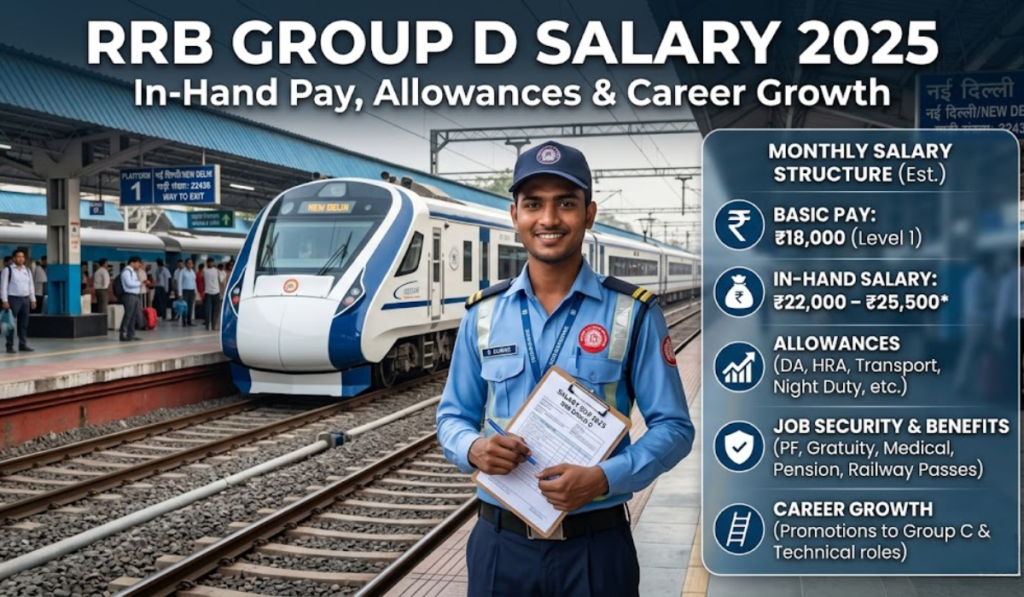
Railway Group D employees are recruited at the Pay Level 1 according to the 7th Central Pay Commission. The minimum basic pay is ₹ 18,000 per month and the pay matrix for Level 1 goes up to ₹ 56,900. In the ongoing railway recruitment, notices for Level-1 posts under 7th CPC Pay Matrix are still being released.
| Salary Component | Railway Group D Salary 2026 |
| Pay Level | Level 1 |
| Basic Pay | ₹18,000 per month |
| Pay Scale | ₹18,000 – ₹56,900 |
| Dearness Allowance (DA) | Applicable as per Central Government rates |
| House Rent Allowance (HRA) | Applicable based on posting location |
| Transport Allowance | Applicable as per rules |
| Other Allowances | As applicable to the post and location |
| Gross Salary | Usually around ₹25,000–₹35,000+ per month, depending on allowances and posting |
| In-Hand Salary | Generally around ₹22,000–₹30,000+ per month after deductions |
| Annual Salary | Approximately ₹2.6–₹3.6 lakh+ depending on allowances |
| Pay Commission | 7th CPC |
RRB Group D Pay Level and the 7th Pay Commission
RRB Group D salaries are governed by 7th Central Pay Commission (CPC), which defined the pay matrix for all central government departments, including Indian Railways. The pay matrix for Group D (as per 7th pay commission) starts from a basic pay of Rs. 18,000 and such employees are placed in Pay Level 1.
Railway Pay StructureApplicable to All Railway Zones in IndiaThe pay structure is common across all railway zones of the country that has been decided based on Regional factors so that irrespective of whether you are working in Western or Eastern railways, no one can have a lower basic salary. The 7th CPC has its own built-in safeguard against inflation as it guarantees periodic revision in dearness allowance.
| Pay Commission | Pay Level | Basic Pay |
| 7th CPC | Level 1 | Rs. 18,000/month |
While the initial base salary might feel unspectacular, that figure is just a starting point: an extensive supplementary allowances package placed atop the basic pay results in total compensation much higher and more competitive than most entry-level private-sector jobs.
RRB Group D Salary Structure: Monthly Breakdown
The monthly salary of RRB Group D is not restricted to the basic pay. The basic number itself will need a few numbers added to it by way of government-mandated allowances, which when taken cumulatively would push the gross salary miles ahead of Rs. 18,000.
This is how the monthly pay scale of a recently hired Group D worker appears.
| Salary Component | Approximate Amount |
| Basic Pay | Rs. 18,000 |
| Dearness Allowance (DA) | Rs. 3,000 to Rs. 6,000 |
| House Rent Allowance (HRA) | Rs. 1,440 to Rs. 4,320 |
| Transport Allowance | Rs. 1,000 to Rs. 2,000 |
| Other Allowances | Varies by posting |
| Gross Monthly Salary | Rs. 22,500 to Rs. 25,500 |
These numbers are estimates, and depend on the city of posting, current DA rates, and individual posting conditions. The basic salary is linked to the DA component, which is revised twice a year by the central government, and it therefore has scope for an increase in gross salary even without formal promotion.
RRB Group D In-Hand Salary
The in-hand or take-home salary is the amount transferred to an employee’s bank account after all statutory deductions are made. This is always lower than gross salary but provides a more realistic view of the monthly income.
Now after deduction from the basic pay for RRB Group D officials, the in-hand salary depends on city classification of posting location. Indian Railways classifies cities into three tiers: X (Metro), Y (Mid-sized cities) and Z (Rural or small towns). The net take-home number is impacted directly and the HRA part changes accordingly.
| City Category | Expected In-Hand Salary |
| X City (Metro cities like Mumbai, Delhi) | Rs. 24,000 to Rs. 25,500 |
| Y City (Cities like Jaipur, Nagpur) | Rs. 23,000 to Rs. 24,500 |
| Z City (Rural or smaller towns) | Rs. 22,000 to Rs. 23,500 |
The in-hand salary for RRB Group D will be approximately Rs. 22,000 Rs. 25,500 per month. A few years into their teaching role, the vast majority of these candidates will have much better earning potential than most of their friends who took jobs with local private employers which are often unwilling to pay more than $30K-40K a year.
Allowances That Form Part of the RRB Group D Salary
Allowances are an essential part of the RRB Group D salary that significantly adds to an employee’s overall earnings. Here’s a deeper dive into each big allowance:
Dearness Allowance (DA)
DA or Dearness Allowance; is a cost of living adjustment paid by the government to employees due to inflation. It is added to the monthly take-home pay and is given in as a percentage, twice a year, January and July, following the announcement of Consumer Price Index (CPI). Since the DA rises with inflation, the total monthly salary rises naturally over time for all employees without a promotion.
House Rent Allowance (HRA)
HRA is reimbursed to cover monthly accommodation expenses. The rate is directly linked to the city classification of the posting:
- X X Cities (Metro): 24% of base pay
- Y Cities: 16% of basic pay
- Z Cities: 8% of basic pay
However, an employee based in a metro city such as Mumbai or Delhi gets HRA much higher than someone working in a smaller town. It is a key factor to consider while checking the RRB Group D salary’s real-world purchasing power in various contenders.
Transport Allowance
Transport Allowance A fixed transport allowance is paid to the employee to meet the daily cost to commute between the home and workplace. It depends on the category of a city and is fixed part of the Railway pay at that level.
Night Duty and Special Allowances
Night Duty Allowance is also provided for employees deployed in night shifts, which increases monthly earnings. Railway administration may decide on issue of extra compensatory allowances at such places with remote, hilly or difficult terrain. Combined, these special allowances can make some postings financially more lucrative than urban ones.
Non-Monetary Benefits
In addition to cash components, employees in Group D can also expect a variety of non-cash benefits that provide significant additional value. This includes free or subsidised medical treatment at Railway hospitals for regular employees and their dependants, free or concessional railway travel passes, getting accommodation in Railway residential quarters in many places, paid annual leave and casual leaves, educational concessions for children. This leads to the RRB Group D salary package, taking into account these benefits, having a much higher effective value than mere cash.
Deductions Applied to the RRB Group D Salary
It is equally important to know deductions as it is to know the gross salary. These are the common deductions made from gross pay every month before the final take-home salary is disbursed.
| Deduction Type | Approximate Amount |
| Provident Fund (PF) | Rs. 1,800/month (10% of basic) |
| National Pension System (NPS) | As applicable |
| Income Tax | As per applicable slab |
| Professional Tax | If applicable in the state |
Monthly PF deduction of Rs. 1,800 is matched with an equally contributing Railway employer, which over the years contributes to a sizable retirement corpus. Most newly recruited Group D staff also fall below the minimum taxable income ceiling, so at early stages of career their income tax deduction is either zero or very low.
Despite these deductions, the net take-home RRB Group D salary is still competitive and financially significant for a fresh state/provisional government job.
RRB Group D Yearly Salary: Annual Earnings at a Glance
Annual income provides a better point of view on this job’s financial advantages. This is what a Group D employee can earn over a full year:
| Calculation Type | Amount |
| Monthly In-Hand Salary | Rs. 22,000 to Rs. 25,500 |
| Annual In-Hand Salary | Rs. 2.64 lakh to Rs. 3.06 lakh |
| Approximate Gross Annual CTC (with all benefits) | Rs. 3.0 to Rs. 3.5 lakh+ |
Central government employees also get productivity-linked bonuses in the festive seasons that can add up to several thousand rupees per year. Because the guaranteed annual increment system guarantees an annual pay increase on the 1st of July (common “birthday” date for all) that steadily raises up the salary floor even though no promotion occurs.
Railway Group D Salary After 3 Years
In Railways the basic pay of Group D employees is ₹18000 1. Normally, the basic pay progresses through the prescribed Level-1 cells in Pay Matrix with applicable annual increment. The minimum monthly pay will reach around ₹19,700 in the case of basic pay after three annual increments. The actual monthly emolument will be larger than this when necessary DA, HRA, transport allowance and other benefits are added.
RRB Group D Salary After 5 Years
An RRB Group D employee in Service for more than 5 years with regular Annual Increment receives nearly ₹20,900 per month Basic pay under Level-1 Pay Matrix. The gross and in-hand salary of the employee shall be decided by the allowances and deductions applied. Hence ₹20,900 is to be taken as the basic pay and not the final take home salary.
RRB Group D Salary After 10 Years
In other words, if you continue to serve for 10 years with annual increments alone (without any promotion or change in pay through any other action), your basic pay will go up to around ₹24,200 per month in Level 1. Railway employees get DA, HRA, transport allowances and other applicable benefits apart from the basic pay so therefore monthly salary can be much more than basic pay.
RRB Group D Career Growth and Promotion Path
The RRB Group D salary and service has an exciting long-term benefit, i.e. Promotion: Indian Railways is a sizable network of railroads with very clear promotion steps. With hard work and a consistent track record of performance, Level 1 employees can rise earn their way up to much higher pay grades over time.
Typical Promotion Ladder
| Current Post | Next Promoted Post |
| Group D Level 1 | Technician Grade III (Level 2) |
| Technician Grade III | Senior Technician (Level 5) |
| Senior Technician | Junior Engineer or Supervisor |
The promotion is based on a combination of selections by seniority and Departmental Competitive Examinations (DCEs) which are conducted internally in Indian Railways. In fact, Group D salary at higher pay levels can vary between Rs. 40,000 and 60,000 or even more in the long term representing a significant increment with respect to the initial group d salary.
Many who have been promoted departmental exams to Group C and Group B posts also have broadened their career scope and numb
Is the RRB Group D Salary Worth It in 2026?
For equivalently qualified entry-level positions in the private sector, we find an average monthly pay of Rs. 10,000 to Rs. 18,000 in much of India on these data and often without PF contributions nor paid leave or health benefits or job security. The RRB Group D salary is in sharp contrast to this comparison for multiple reasons:
- No delays or salary cuts, guaranteed on-time monthly payment
- Half-yearly automatic DA revisions that safeguard real income against inflation
- National Pension System – Contributors driven by lifelong retirement stability
- Hospitals and clinics for its employees along with entire family
- Support for travel concessions and accommodation for residential students
- Job protection under the Constitution that private employment cannot guarantee
With exceptional value for candidates prioritizing financial security, career predictability and permanent government benefits over the insecurities of the private sector, the RRB Group D pay structure is indeed phenomenal. This is particularly advantageous for candidates hailing from Tier-2 and Tier-3 cities, with the in-hand salary being extremely competitive compared to private organisation jobs at the local level.
Conclusion
The RRB group D salary provides a good amount of financial security to all those candidates who want to pursue a career in Indian Railways. Starting around Rs. 18,000 per month as base salary with the 7th Pay Commission, a full compensation package Dearness Allowance + House Rent Allowance + Transport Allowance and all non-cash benefits packaged together puts effective monthly income anywhere between Rs 22,000 – Rs 25,500 depending on posting location.
But the larger picture is more hopeful still. The salary offered by the RRB Group D job is one of the most desirable entry-level government offers in India today, combining annual increments, six-month DA updates, three sets of promotions policies as well as post-retirement pension and unparalleled stability that a central government provides. For all those who are gearing up for the forthcoming RRB Group D recruitment examination, going through this salary structure in its entirety is the first step in a well-informed career decision with confidence!
FAQs
Q1. RRB Group D basic pay?
The basic pay of an RRB Employee in Group D( Level 1 pay matrix as per 7th Central Pay commission)= Rs. 18,000/ month.
Q2. What is the monthly in-hand salary of RRB Group D?
After dividing all the other expenses, an in-hand salary will usually be between Rs. 22,000 and Rs. 25,500/month based on city category of posting location and current DA rates.
Q3. Are allowances included in RRB Group D salary?
Yes. The basic pay shall be a part of the overall remuneration, which consists of House Rent Allowance, Dearness Allowance, Transport Allowance, Night Duty Allowances (if applicable), and other post-related perks.
Q4. Is salary same for all railway zones in India?
For all zones, the base pay is the same. However, total take-home salary varies as HRA depends on the categorization of posting centres X (Metro), Y (Mid-sized) and Z (Rural).
Q5. What is deducted from RRB Group D salary?
Monthly deductions typically include Provident Fund contributions (Rs. 1,800 per month), NPS contributions and income tax if applicable. Most new employees pay little or no income tax in the early years because they are below the taxable threshold.
Q6. Is there any promotion available for RRB Group D employee to higher posts?
Yes. Group D employees can move to Technician, Senior technician and supervisory roles through departmental competitive examinations and promotions based on seniority for a service period of 10 to 15 years which are at much higher pay levels.
Q7. What is the salary per annum of an RRB Group D worker?
Approximate annual in-hand salary: Rs. 2.64 lakh to Rs. 3.06 lakh Number is much higher when accounting for festival bonuses, increments and other non-monetary benefits as well.
Read More: Home Guard Salary in India || GST Inspector Salary || SSC Stenographer Salary